Gold Loses Safe-Haven Status, Bitcoin No Longer Offers Risk Reward Either
Baca dalam 60 detik
- Rasio Sharpe emas setahun terakhir jatuh ke -0,53, sementara bitcoin -0,75, menandakan keduanya tak lagi memberi kompensasi atas volatilitas.
- Penurunan ini lebih mencerminkan pergeseran siklus alokasi modal ke aset berimbal hasil pasti ketimbang kekalahan bitcoin atas emas.
- Dalam jangka panjang, emas masih unggul secara risk-adjusted, tetapi tekanan dolar AS dan sikap hawkish The Fed membayangi prospek keduanya.
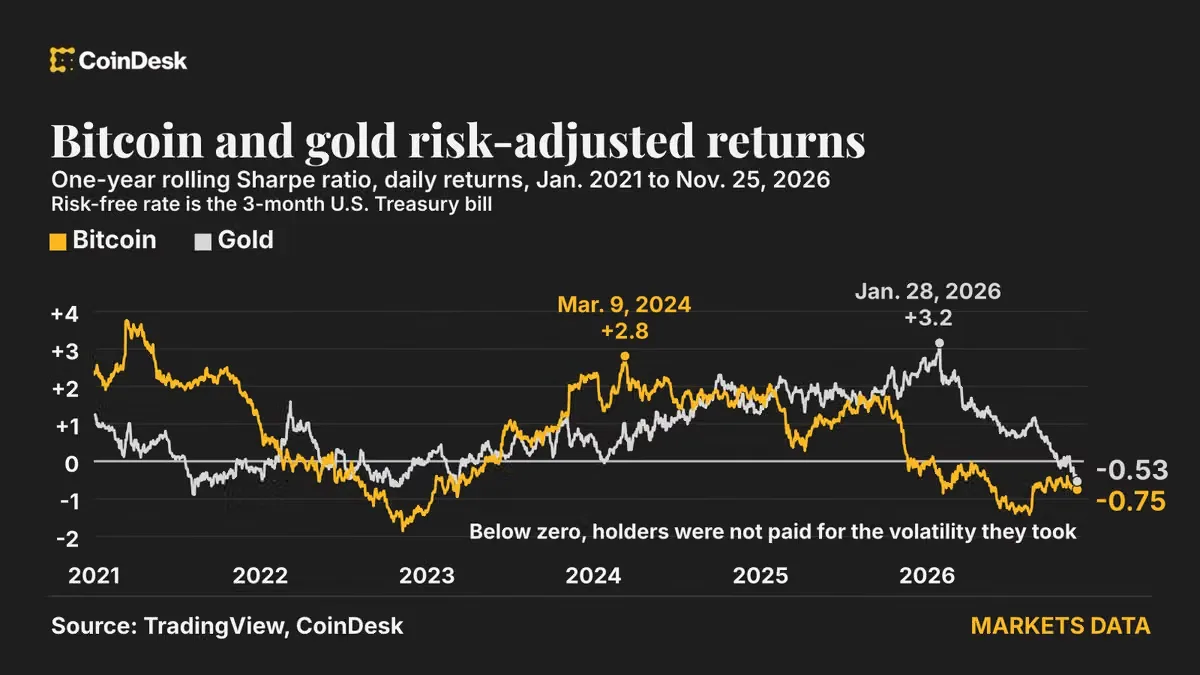
Gold is no longer the darling among hedging assets. For the first time in nearly three years, the precious metal has posted a negative Sharpe ratio, signaling that investors are no longer being compensated for the price volatility risk they bear. Bitcoin, often promoted as digital gold, has fared little better.
Based on CoinDesk calculations, gold's Sharpe ratio over the past one-year period stands at -0.53, while bitcoin's is -0.75. These negative figures show that both are losing out to cash-equivalent instruments offering guaranteed yields, such as short-term government debt. The Sharpe ratio itself is a standard measure of how much return is earned above the yield on three-month US Treasury bills, divided by the asset's volatility.
Interestingly, the convergence of these figures does not mean the fundamentals of gold and bitcoin have truly merged. According to Tim Sun, a senior researcher at HashKey Group, the decline in gold's Sharpe ratio actually signals that investors are reassessing the entire class of non-yielding assets. "The main competitors for gold and bitcoin right now are not each other, but cash-equivalent assets and high-quality bonds that offer relatively certain yields," he told CoinDesk.
The collapse in gold's Sharpe ratio has come alongside the slump in both assets' prices. Gold peaked at US$5,589 per ounce on 28 January before dropping 37%. Meanwhile, bitcoin has fallen about 33% since the start of the year to near US$59,000. Bitcoin's volatility, generally about 50% greater than gold's, keeps it the riskier asset.
Macro factors are the main cause. The strengthening US dollar, which reflects shifting expectations for the Fed, has weighed on both. According to Markus Thielen, founder of 10x Research, the shift in the US central bank's stance began with Kevin Warsh's nomination as Fed chair in January, followed by the Fed's decision to drop its easing bias in June and gradually move to a hawkish position. "Because both are priced in dollars, a stronger US currency makes them more expensive for international buyers. In addition, a hawkish Fed weakens the appeal of non-interest-bearing assets like gold and bitcoin," Thielen explained.
"The chart does not show that bitcoin has matured into digital gold. Rather, it shows gold moving down toward bitcoin in terms of risk-adjusted returns, after gold's extraordinary trend reversed sharply," said Griffin Ardern, co-founder and portfolio manager at Primal Fund.
Despite the gloomy short-term outlook, the historical record shows gold still holds a structural advantage over bitcoin. Over a three-year horizon, gold's Sharpe ratio is steady at 0.77 versus bitcoin's 0.46. Over five years, gold leads with 0.60 versus 0.21. The only extended period in which bitcoin outperformed began in 2020, when Nasdaq-listed company Strategy (MSTR) started accumulating bitcoin as a long-term investment. Yet even with that historic bull run, bitcoin's long-term Sharpe ratio leads gold by only a thin 0.17 points.
For Indonesian investors, this dynamic is relevant given that gold remains a favorite hedging instrument, while bitcoin is increasingly popular among retail investors. Weakening purchasing power due to a stronger US dollar could weigh on domestic gold demand, but on the other hand, the price correction could be an accumulation opportunity for those who believe in the long-term thesis. The question is whether the Fed will soften next year, or instead maintain a hawkish stance that leaves non-yielding assets increasingly sidelined.