Asteroid 2026 QQ8 Becomes Earth's 'Mini Moon,' Lasting Only Until December
Baca dalam 60 detik
- Asteroid 2026 QQ8 terperangkap gravitasi Bumi sejak April dan akan lepas pada awal Desember 2026.
- Objek berukuran dua meter itu teridentifikasi sebagai batuan alami, bukan sampah antariksa, setelah pengamatan lintasan.
- Penemuan ini menegaskan bahwa bulan mini mungkin kerap hadir tanpa terdeteksi, dan observatorium generasi baru berpotensi mengungkap lebih banyak.
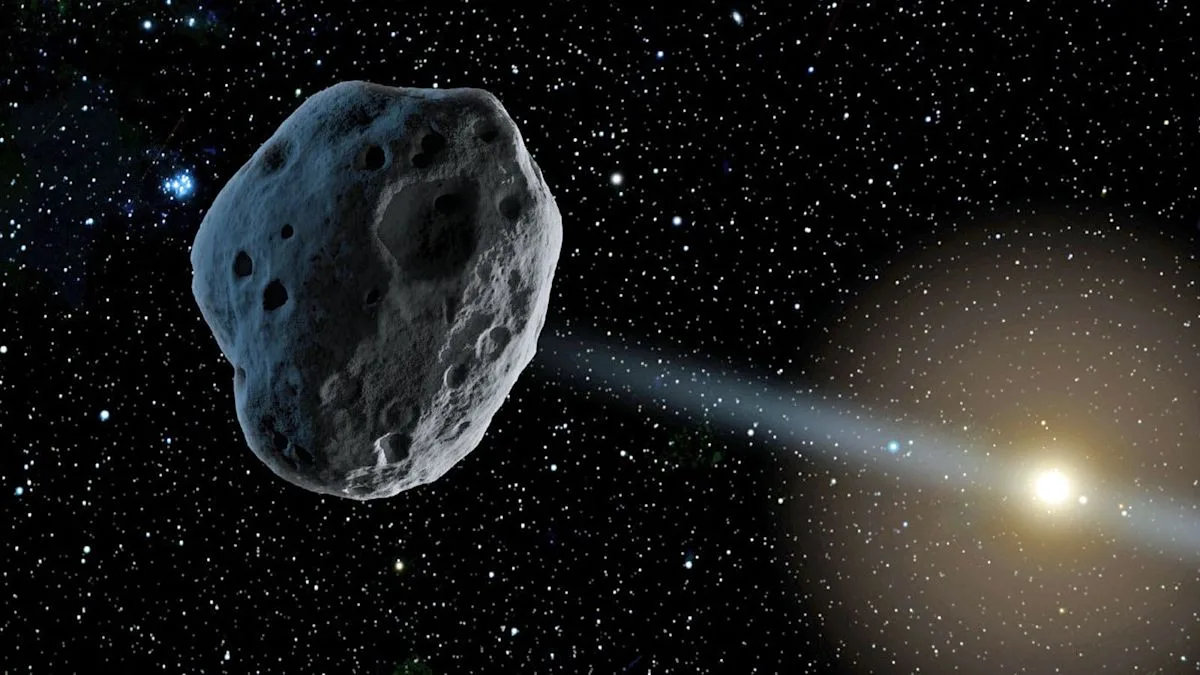
Earth once again has a temporary natural satellite. A small asteroid later named 2026 QQ8 was pulled in by the planet's gravity last April and is expected to break free in early December. The event is a reminder that our solar system is not a static space but a dynamic traffic of celestial bodies, most of which still escape observation.
According to a CNN report, the asteroid is about two meters in diameter and officially received the designation 2026 QQ8 from the Minor Planet Center under the International Astronomical Union in late October. The center is tasked with monitoring asteroids, comets, and other small celestial bodies across the solar system. Although dubbed a "mini moon," the object is not a permanent satellite of Earth. Once it escapes the planet's gravitational influence, it will return to orbiting the Sun independently.
The mini moon phenomenon is not new. Previously, asteroid 2006 RH120 stayed around Earth for about a year, while 2020 CD3 was recorded orbiting for roughly three years. In 2024, asteroid 2024 PT5 accompanied Earth for about two months before continuing its journey. However, this discovery of 2026 QQ8 drew attention because of the unusual identification process.
Krisztián Sárneczky, research coordinator at the Konkoly Observatory in Hungary, first detected the object in August during routine observations of near-Earth asteroids. He told CNN he initially thought it was like the hundreds of other asteroids he had found. "Its unique nature only became apparent after precise orbit calculations," he said, as quoted by CNN.
A debate briefly arose among astronomers: whether 2026 QQ8 was a natural asteroid or a piece of space debris, such as a dead satellite or a fragment of one. To confirm, the research team spent several weeks observing how solar radiation affected the object's trajectory. Observations with the Lowell Discovery Telescope in Arizona and the University of Hawaii's 2.2-meter telescope at Mauna Kea ultimately confirmed that the object was natural in origin.
Although its exact origin is unknown, most near-Earth asteroids come from the asteroid belt between Mars and Jupiter. Gravitational interactions over millions of years can alter their trajectories until they approach the inner solar system. Under certain conditions, an asteroid approaching Earth at a relatively low speed can be temporarily bound by the combined gravity of Earth and the Moon.
Minor Planet Center director Matthew Payne confirmed that 2026 QQ8 poses no collision risk with Earth. Even if the asteroid entered the atmosphere, its tiny size would make it break up without harmful impact. Payne also revealed that although documented mini moons remain few, astronomers believe such objects routinely accompany Earth undetected. "On average, there might be one object out there at any given time," he told CNN.
The difficulty in detecting mini moons lies in their small size and faint light, plus their speed and apparent distance, which make existing astronomical surveys struggle to recognize them. However, advances in observation technology are expected to significantly increase the number of known temporary satellites. According to Payne, astronomers have identified about 40,000 near-Earth objects and about 1.5 million bodies across the solar system.
The Vera C. Rubin Observatory in Chile, equipped with the world's largest digital camera for optical astronomy, is running a ten-year survey called the Legacy Survey of Space and Time (LSST). The project is expected to broaden understanding of the solar system by finding previously undetected asteroids, comets, and other celestial bodies, while also observing distant galaxies. Payne estimates the survey could raise the number of known solar system objects from 1.5 million to five million.
For Indonesia, this phenomenon is more than just international science news. As an archipelagic country located on the equator, Indonesia has several observatories and active amateur astronomy communities. Strengthening observation capacity, whether through telescopes at the Bosscha Observatory or other facilities, could be an opportunity to take part in near-Earth object detection. In addition, awareness of the potential for small approaching asteroids is also relevant to space disaster mitigation efforts, even though 2026 QQ8 itself is not dangerous.
Going forward, the question is no longer whether Earth will capture another mini moon, but how quickly we can identify it. With the arrival of next-generation observatories, the list of mini moons may grow longer, opening the way for deeper study of solar system dynamics and the origins of celestial bodies passing near our planet.