REGENT's Seaglider Makes First Test Flight: Electric Winged Vessel Ready for Production
Baca dalam 60 detik
- Viceroy Seaglider buatan REGENT berhasil melakukan penerbangan berawak pertama di Teluk Narragansett, Rhode Island, dengan 12 baling-baling listrik dan bertenaga hidrofoil.
- Kendaraan hibrida kapal-pesawat ini menawarkan kecepatan hingga 180 mph dan daya angkut 12 penumpang atau 3.500 pon kargo, menyasar pasar feri cepat dan operasi militer AS.
- Keberhasilan ini membuka jalan bagi produksi massal, tetapi tantangan regulasi dan adopsi di pasar Asia, termasuk Indonesia, masih harus diatasi.
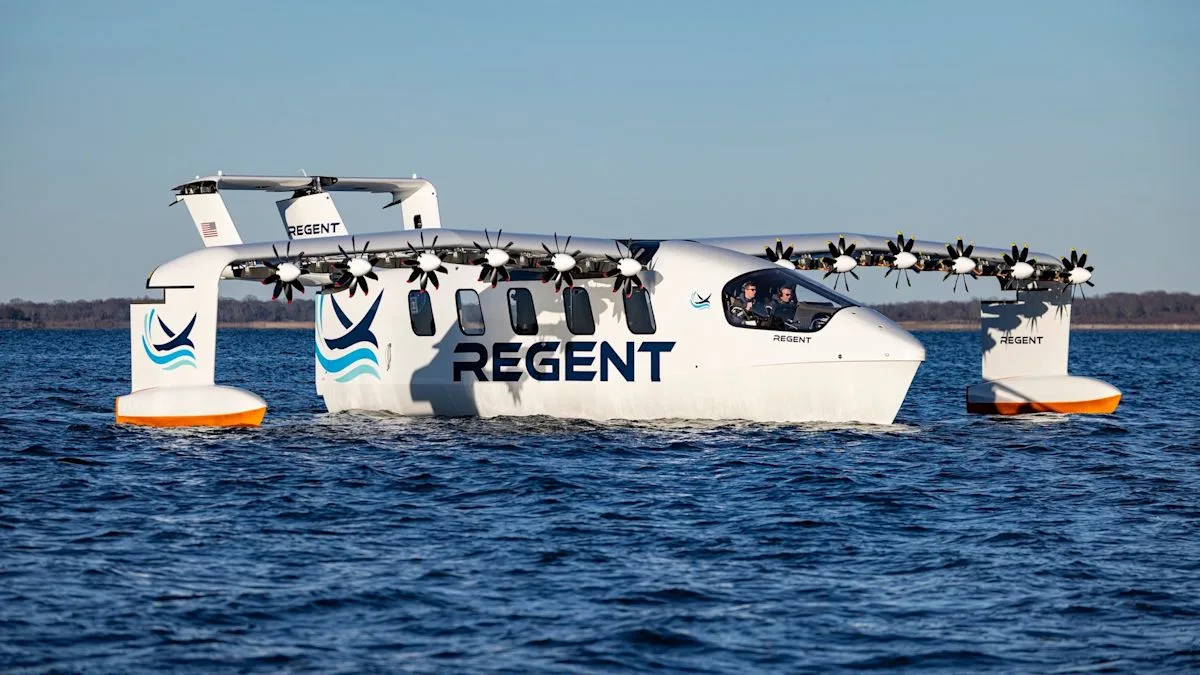
A strange vessel with wings and a tail resembling a whale was seen floating in the calm waters of Narragansett Bay, Rhode Island, earlier this month. Twelve electric propellers—six on each side—began to spin and pushed the vessel forward. Slowly, its hull lifted from the water thanks to hydrofoils, then it flew about 10 meters above the bay for 30 seconds before landing softly again. The first crewed flight covered 1,956 feet (596 meters) and marked an important milestone for REGENT, a Rhode Island startup developing the Viceroy Seaglider.
The Viceroy is a hybrid vehicle that combines the ease of a boat with the speed of an aircraft. According to REGENT, the vessel is designed to carry 12 passengers at speeds of up to 180 mph (290 km/h) or haul 3,500 pounds (1,587 kg) of cargo. The technology used is wing-in-ground-effect (WIG), harnessing the aerodynamic phenomenon of ground effect to create extra lift when flying close to the water's surface. This approach is claimed to be more fuel-efficient than conventional aircraft.
"Completing this test flight validates years of hard work and gives us the confidence to enter full production," said one of REGENT's co-founders and CTO in an official statement. He added that the Seaglider flew as smoothly and safely as designed.
The Viceroy is not the first of its kind. The Soviet Union once developed the ekranoplan, a giant Cold War-era vehicle that exploited ground effect. The most famous was the 380-ton "Caspian Sea Monster," longer than an Airbus A380 and capable of reaching 340 mph. However, the ekranoplan had weaknesses: it struggled to take off in choppy water and was difficult to dock. REGENT addresses that problem with retractable hydrofoils—underwater wings that lift the hull as speed increases, reducing wave drag, then fold back after flight.
Beyond commercial use, REGENT is also working on a smaller military version called "Squire." This vehicle operates autonomously and is designed to carry a 50-pound payload. US military interest is already evident: REGENT has secured a US$15 million contract with the US Marine Corps, as well as development agreements with Special Operations Command and the Coast Guard. Last year, the Viceroy completed field demonstrations for simulated coastal evacuation and open-sea rescue.
Despite its ambition, in practice the Viceroy will compete with established helicopters. Its advantages lie in greater carrying capacity and electric motors that are far quieter than noisy helicopters. However, aviation regulatory and certification challenges in various countries could be obstacles. In Indonesia, where inter-island transport is a backbone, technology like this could potentially fill the gap between fast ferries and pioneer aircraft. Yet infrastructure readiness and low-altitude flight rules remain big questions.
Going forward, REGENT plans to mass-produce the Viceroy and expand testing. If successful, this vehicle could change how people travel in coastal areas, including in archipelagic countries like Indonesia. Will the seaglider become the transport mode of the future or just a niche for the military and ultra-wealthy tourists? Time will tell, but REGENT's move is worth watching.